
Displaying items by tag: knoxville environmental activism
Get to know a Black Girl Environmentalist
 Members of the Black Girl Environmentalist Knox HUB will be the featured guests at the July 8 installment of Green Drinks Knoxville at 5:30 p.m. at Alliance Brewing Company, 1130 Sevier Ave. Knoxville. Green Drinks Knoxville
Green Drinks Knoxville explores how black and brown people bear the brunt of climate change
KNOXVILLE — Green Drinks Knoxville welcomes Black Girl Environmentalist Knox HUB for a conversation about environmental justice, community, and why Black-led environmental spaces matter.
The July installment of Green Drinks Knoxville is set for 5:30 p.m. July 8 at Alliance Brewing Company, 1130 Sevier Ave., Knoxville.
Learn about the work of Black Girl Environmentalist, the role of the local hub and co-hub leaders, and explore how environmental and climate issues disproportionately impact Black and Brown communities around the world. Come learn, ask questions, and be part of a meaningful discussion about building a more just and inclusive environmental movement.
- black girl environmentalist
- black girl environmentalist knox hub
- green drinks knoxville
- alliance brewing company
- wesleigh wright knoxville
- kalil white
- knoxville environmental activism
- environmental justice
- southern appalachian environmental justice
- climate change
- climate change in appalachia
- climate change and environmental justice
Invasive plants are choking the Urban Wilderness
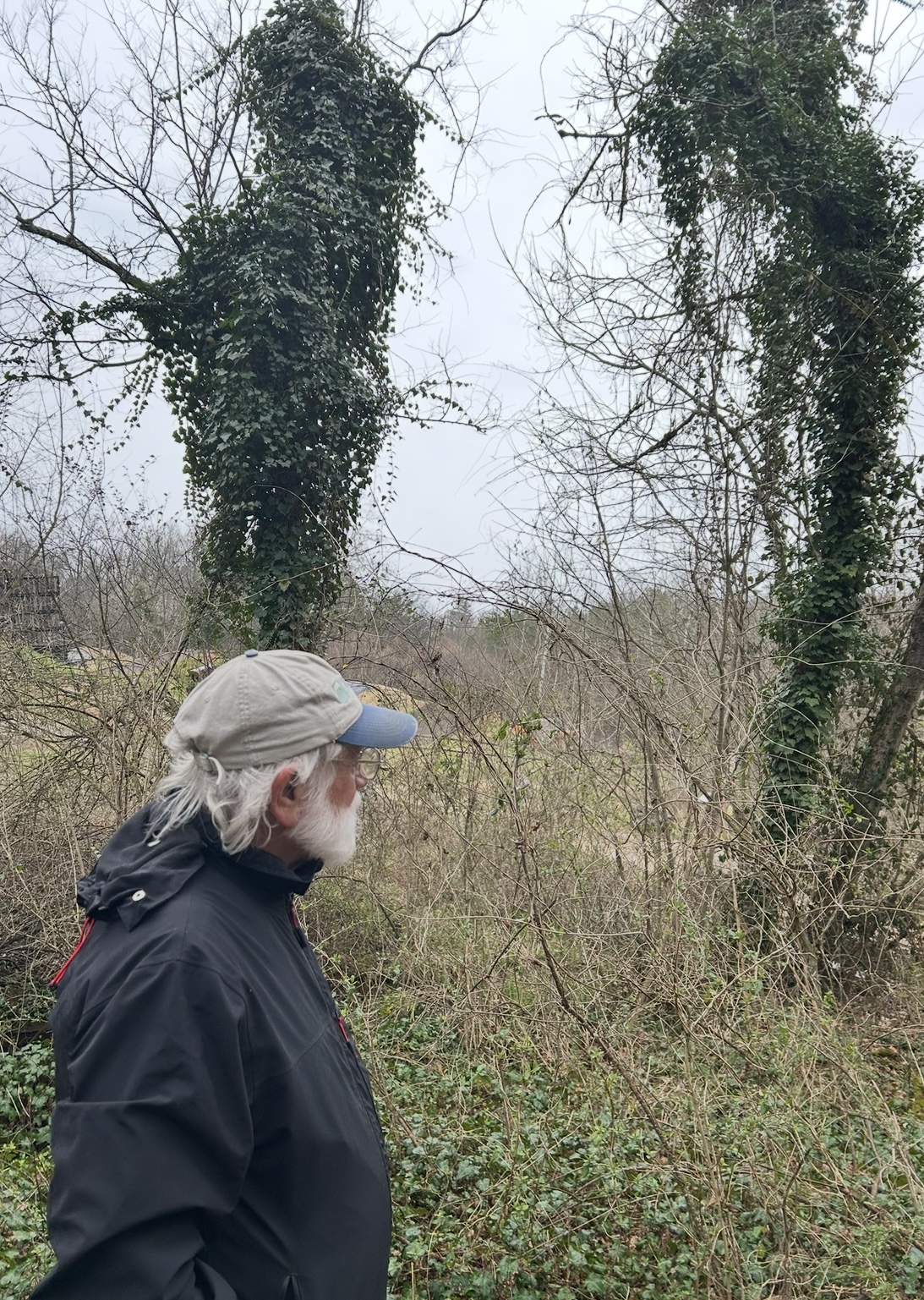 Retired University of Tennessee philosophy professor John Nolt has been waging a one-man campaign against destructive invasive plants, such as the ivy seen in the background strangling live trees, in the Baker Creek Preserve in South Knoxville. JJ Stambaugh/Hellbender Press
City taps people power to fuel fight against creeping exotic plants that are displacing native species
KNOXVILLE — Death is slowly overtaking the Urban Wilderness, one tree at a time.
A host of invasive species have taken root in the 1,000-acre network of trails, parks, and quarries that draws legions of outdoor enthusiasts from across the Knoxville metropolitan area and beyond. Their prolific growth may look healthy to the untrained eye, but in reality their presence is a neon-green warning sign.
English ivy, wintercreeper, honeysuckle, and privet are just some of the non-native species of flora that are slowly taking over the region’s forested spaces, threatening the very existence of the countless plants and animals that depend on the local food web.
The problem isn’t new, but it’s been growing more visible with each passing year and has drawn the attention of environmentalists, government officials, and local groups of nature lovers.
For instance, retired University of Tennessee philosophy professor John Nolt has been waging a one-man campaign against the destructive plants in the Baker Creek Preserve in South Knoxville.
Several times a week, he walks the trails and takes note of how thick bands of brilliant green vines have wrapped themselves around the trunks of elm, birch, and sycamore trees.
Get plugged in to the facts about electric vehicles during SACE webinar

KNOXVILLE — You’re invited to join a Southern Alliance for Clean Energy webinar, “Understanding EVs: Real People Share Real Stories of Electrifying Their Ride,” at 11:30 a.m. Thursday, Aug. 29.
A panel of electric vehicle (EV) owners and drivers will share stories and insights from their experiences with EVs. Learn more about what it’s like to own, charge, travel and save money with an EV, plus hear advice from real people who have gone electric! Panelists for this webinar will include:
-
EVNoire Associate Director Tarique André Miller, on EV charging levels and networks, best practices on charging, maintenance cost savings, plus EV incentives and opportunities for all
- SACE Electric Transportation Equity Manager Madelyn Collins and East Tennessee Clean Fuels Community Engagement Liaison Wesleigh Wright, on what they learned about EV range and community charging during their first ever EV road trip
-
SACE volunteer Sara Vinson, on purchasing an EV, using federal tax credits to save money on an EV, and benefiting from the low maintenance of EVs (including her vow to never get an oil change again!)
- sace webinar
- sace
- southern alliance for clean energy
- madelyn collins
- clean energy webinar
- wesleigh wright
- electric cars
- electric vehicles
- electric bus
- are electrical vehicles good to drive
- electric vehicle testimonials
- knoxville environmental activism
- east tennessee clean fuels
- ev maintenance
- ev charging
- ev market
Sequoyah Hills is now officially the arboretum we always shared
 Many such new identifying tags highlight trees such as this red cedar in the newly designated Sequoyah Hills Arboretum near Bearden in Knoxville. Ben Pounds/Hellbender Press
The arboretum designation will allow for more extensive tree walks, scout projects, school outings, and other educational programs on the value and beauty of native trees
KNOXVILLE — A small crowd of volunteers with tags and tools descended on Sequoyah Park on a February afternoon, preparing to affix identifying labels to the bark of old trees in one of the city’s most storied neighborhoods.
Sequoyah Park sits along the Tennessee River at 1400 Cherokee Boulevard, tucked behind the Sequoyah Hills neighborhood but open to all who want to run, walk, cycle, or enjoy its open fields and other features. It’s Tennessee Valley Authority land, maintained by the city. The many species of native trees that tower over the park’s long field got recognition this year. The park and other Sequoyah Hills neighborhood areas are now part of the Sequoyah Hills Arboretum, an accredited level one ArbNet arboretum.