
A project titled Southeast Tennessee Hydrogen Hub and Decarbonization Zone — led by REITEC Holdings, the City of Chattanooga and Moccasin Bend — is on a list of projects the U.S. Department of Energy (DOA) discouraged in 2023 from submitting a full application for federal hub funding.
The Federal Hydrogen Hub Program
Another project, titled Southeast Hydrogen Hub — including Tennessee interests and the Tennessee Valley Authority (TVA) — was encouraged by DOE to apply for funding, but as reported by Earthjustice, it was not among the seven regional hubs ultimately selected by DOE to receive the $8 billion in grants for the Federal Hydrogen Hub Program.
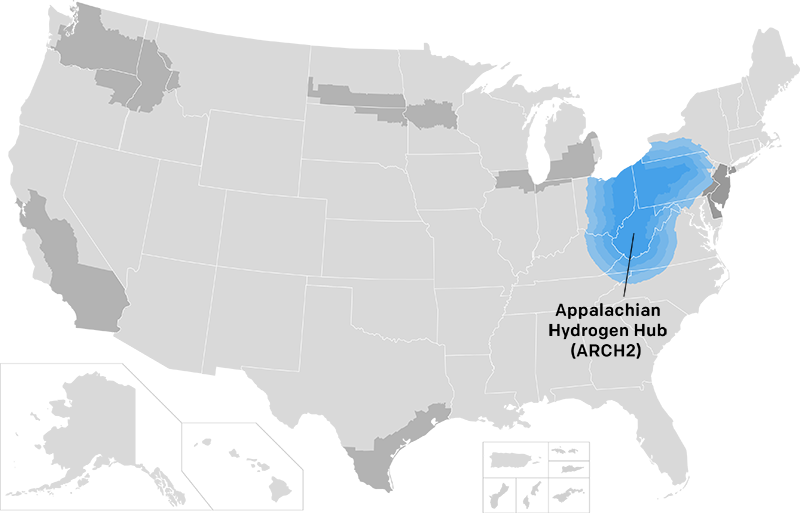
Of the chosen programs, the Appalachian Hydrogen Hub (ARCH2) in West Virginia, Ohio and Pennsylvania barely touches our Katuah bioregion. This hub was supposed to be eligible for up to $925 million in grants. In July 2024 it was awarded $30M for Phase 1 activities, which were expected to last up to 36 months and include planning, design and community and labor engagement.
On Jan. 28, 2025 however, DOE published a memo instructing all funding recipients and subrecipients to “cease any activities” associated with Community Benefits Plans.
The memo indicates that additional guidance will follow, and we will update the Guide as we get information about how the Hub Program will be affected.
Clean hydrogen vs grey hydrogen
20-second explainer.
Clean hydrogen is derived from water by electrolysis with energy from nuclear or renewable solar, wind or hydro power. Many promoters of the renewable sources prefer to call their’s green hydrogen or blue hydrogen.
Even today, barely more than one percent of global hydrogen demand is produced from low-carbon sources.
About 60 percent of grey hydrogen is made from natural gas, 20 percent from coal and most of the rest from oil, releasing massive amounts of carbon dioxide. Thus, despite the zero tailpipe emissions of hydrogen vehicles — good for crowded city canyons — their impact on climate change is negligible only because such vehicles are exceedingly rare.
Sci-Tech-Today has a collection of hydrogen statistics with many graphics. Take projections with a grain of salt!